Service area · Downtown Miami
Water damage restoration in Downtown Miami
Downtown condo or office leaking? Shut the fixture or unit valve if safe, steer clear of standing water close to outlets, cords or appliances, tell building management, then call us.
One call connects you with a local restoration crew that serves your address.
Downtown Miami in public records: FEMA, the Census Bureau and Miami-Dade County. These are not counts of our own jobs.
- NFIP flood insurance claims
- 113
- Losses 1979–2026; top storms Hurricane Irma (14) and Hurricane Andrew (13)
- Homes that are rented
- 78.9%
- Of occupied homes; Census estimate ±3.1 points
- Homes built in 2000 or later
- 80.3%
- Census estimate ±3.5 points
- Area in a high-risk flood zone
- 52.1%
- FEMA Special Flood Hazard Area; 1.5% is coastal zone VE
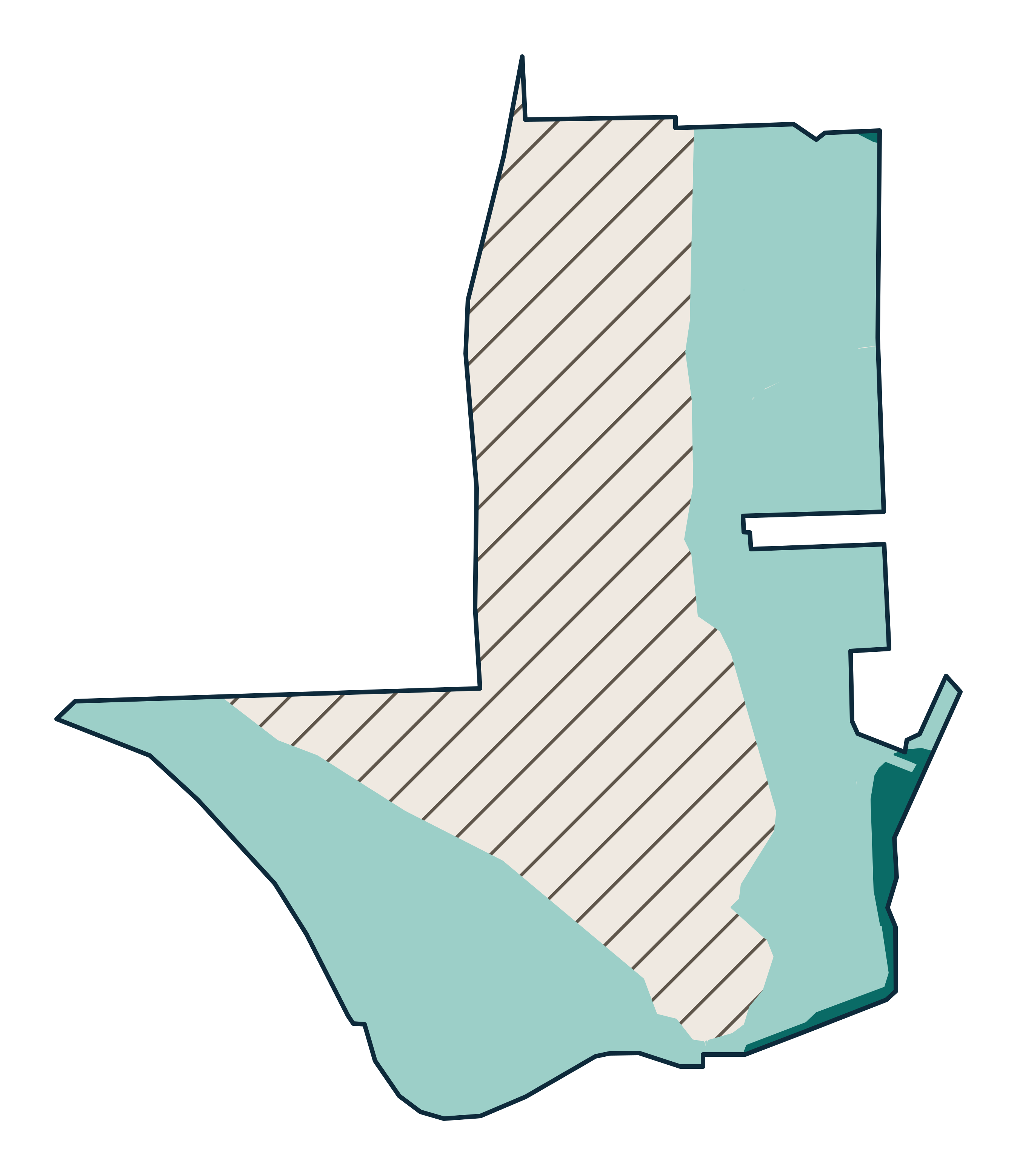
- High-risk flood zone (AE)
- Coastal zone with waves (VE)
- Outside the high-risk zones
For water damage in a Downtown Miami condo, rental, office or shop, call us and tell the building’s management as well: by Census estimates, 87.2% of Downtown homes are in buildings of 50 or more units. (US Census Bureau)
On this page
- Water damage in a Downtown condo, rental or office: who do I call first?
- Does Downtown Miami flood, and how often?
- How does water get into Downtown buildings: rain, river or bay?
- Downtown Miami flood insurance claims: which storms, and which years?
- Repairing a historic Downtown building: what does the City require first?
- Will a floodwall protect Downtown Miami from storm surge?
- Water from the condo above: who pays, and can I sue?
- What sets the cost of water damage restoration in Downtown Miami?
- Questions
- Sources and method
Water damage in a Downtown condo, rental or office: who do I call first?
In a condo, a rental or an office, take these steps in order; the fourth applies only to a historically designated building:
- Close the fixture’s valve or the unit’s shutoff if you can do it safely, and keep everyone away from outlets, cords and appliances in or near standing water; the checklist for the first hours covers electricity, gas leaks, photos and receipts.
- Tell the building: in a condo, the manager or the association, and the owner upstairs if the water comes from there; in a rental, your landlord or the management company; in an office or a shop, the property manager.
- Call us, giving the building’s address and saying where the water is coming from, whether a pipe or fixture, the unit above or flooding off the street or the river: we connect you with a local restoration crew that serves your address.
- In a historically designated building, call the City’s preservation staff the same day: the City requires a certificate of appropriateness before repairs and says its staff can usually review repairs and minor alterations quickly. Don’t hold up the water removal and drying for it, but ask the staff before anything is torn out or replaced. (City of Miami)
By Census estimates, 78.9% (±3.1 points) of Downtown’s occupied homes are rented, so for most households here the building contact in step 2 is a landlord or a management company. (US Census Bureau)
Does Downtown Miami flood, and how often?
It does: NOAA’s Storm Events Database has 19 flood reports naming downtown Miami since 2009, 4 involving high or king tides. Reports that also name Brickell or Edgewater are counted on those neighborhoods’ pages as well; 9 of the 19 name neither. (NOAA NCEI)
Among them are significant flooding in the Omni area on June 5, 2009, and, on May 12, 2025, roadway flooding that police reported on Biscayne Boulevard from NE 10th to NE 14th Street after heavy thunderstorm rain. (NOAA NCEI)
Each of these records lists who reported it, police in the 2025 Biscayne Boulevard case; our reading is that floods no one reported are missing, so the records tell you where Downtown floods more reliably than how often it does. (NOAA NCEI)
Of Downtown Miami’s area, 52.1% is in a FEMA Special Flood Hazard Area on Miami-Dade County’s FEMA flood zone layer: 50.6% in zone AE and 1.5% in coastal zone VE, where storm waves add to the flooding. For your own building, the zone shows when you search the address with Miami-Dade County’s flood zone map. (Miami-Dade County; Code of Federal Regulations)
Downtown, as mapped here, covers 3.26 km² across the City sub-areas in the table below. Bayfront, Bicentennial Park and Omni/PAC meet Biscayne Bay; Riverfront and Lummus Park reach the Miami River, which the CBD touches only at its southern end; Government Center, MDCC, Parkwest and Media Art Entertainment sit inland, and Media Art Entertainment and Omni/PAC border Edgewater to the north. (City of Miami; Miami-Dade County)
| Sub-area | Area (km²) | High-risk flood zone | Zone VE |
|---|---|---|---|
| Bayfront | 0.28 | 100.0% | 15.5% |
| Bicentennial Park | 0.27 | 100.0% | 0.0% |
| Riverfront | 0.25 | 95.7% | 0.0% |
| Omni/PAC | 0.35 | 92.5% | 0.3% |
| Lummus Park | 0.25 | 88.2% | 0.0% |
| Government Center | 0.38 | 39.7% | 0.0% |
| CBD | 0.55 | 31.2% | 0.6% |
| Parkwest | 0.48 | 9.8% | 0.0% |
| MDCC | 0.08 | 0.1% | 0.0% |
| Media Art Entertainment | 0.38 | 0.0% | 0.0% |
How does water get into Downtown buildings: rain, river or bay?
NOAA’s National Hurricane Center traced Hurricane Irma’s flooding in downtown Miami, an area its report takes to include Brickell, to a likely combination of heavy rain and urban runoff, waves trapped behind seawalls after washing over them, and seawater coming up from below through the city’s drainage systems. (NOAA National Hurricane Center)
NOAA’s Storm Events Database has also logged high-tide flooding on Biscayne Boulevard and along the river, and flooding that got inside buildings: (NOAA NCEI)
- October 3, 2017: high tide flooding left 9 to 12 inches of water across Biscayne Boulevard just north of the Epic Hotel. (NOAA NCEI)
- October 13, 2019: tidal flooding at high tide along the Miami River, Downtown’s southern edge, and in coastal areas that included Downtown Miami and Brickell across the river. (NOAA NCEI; City of Miami)
- June 4, 2022: severe flooding in several areas of Brickell, Downtown Miami, Little Havana and Shorecrest entered buildings, closed many streets and stranded vehicles. (NOAA NCEI)
The City counts Tidal Backflow Valve #37, at Maurice A. Ferre Park in downtown Miami, among its stormwater and flood prevention efforts; our reading is that it targets the third Irma route, seawater pushing up through the drains. (City of Miami)
Downtown Miami flood insurance claims: which storms, and which years?
The chart below plots Downtown Miami’s 113 NFIP flood insurance claims by year of loss, 1979–2026, and labels its three tallest bars: 2017 (19 claims), 1979 (13) and 1992 (13). (FEMA)
By storm name, Hurricane Irma in 2017 brought the most (14 claims, $751,842 paid), followed by Hurricane Andrew in 1992 (13, $253,425) and Hurricane Irene in 1999 (10, $112,442); FEMA does not give every claim a storm name, so a tall bar need not match a storm. (FEMA)
A net payment went out on 59 of the 113 claims, $2,999,167 in total, not adjusted for inflation; before you file a claim of your own, read how a flood policy differs from homeowners coverage. (FEMA)

Repairing a historic Downtown building: what does the City require first?
Before any water damage repair on the Olympia Theater and Office Building or another designated building in the old commercial core, the City requires a certificate of appropriateness, even for a window replacement. (City of Miami)
Smaller repairs may get an on-site staff review and a standard certificate; large repairs will likely need a special certificate from the Historic & Environmental Preservation Board, whose review can take up to two months and carries a fee based on the proposed work. (City of Miami)
The City’s Downtown Miami Historic District covers the heart of the old downtown commercial area, in styles that include Masonry Vernacular, Art Moderne and Neoclassical Revival; the Olympia, built in 1925, is one of the City-listed historic sites inside it. (City of Miami)
Before any repair, the City recommends talking the project over with its preservation staff; its repair page names a staff contact for the Downtown National Register District. (City of Miami)
Under the federal flood insurance program’s rules, a repair costing half or more of a building’s market value counts as a “substantial improvement”, but work on a historic building that keeps its designation does not; ask the City’s floodplain administrator what that means for your building before the repair is scoped. (Code of Federal Regulations)
Will a floodwall protect Downtown Miami from storm surge?
One was proposed: the Army Corps’ June 2020 draft plan for its Miami-Dade Back Bay study, as the Miami DDA describes it, had a 10-foot floodwall east of Biscayne Boulevard from I-395 to the Miami River and a large sector gate at the river’s mouth. (Miami DDA)
The Chief’s Report of August 26, 2024 left both out: its recommended plan is nonstructural only, voluntary elevation and floodproofing of buildings in a subset of vulnerable, disadvantaged communities. (US Army Corps of Engineers)
At a July 28, 2025 webinar, the Corps and Miami-Dade County named Miami River Expansion East and West as new focus areas of the study and said Phase II would keep investigating nonstructural measures for an August 2027 Chief’s Report. (US Army Corps of Engineers)
Water from the condo above: who pays, and can I sue?
In a condo, who pays depends on how Florida’s condominium statute divides the cost among the association, each owner’s own coverage and, when negligence caused the leak, the owner responsible; whether you can sue the owner above is a question for a Florida attorney, not for us or the crew. (Fla. Stat. 718.111)
In the Miami DDA’s Central Business District, condos make up 67.5% of all multifamily units. (Miami DDA)
What sets the cost of water damage restoration in Downtown Miami?
We do not publish prices; our cost guide sets out what a restoration estimate covers, from water removal and drying to the repairs. For a designated Downtown building, a large repair will likely also bring the preservation board’s fee and up to two months of review. (City of Miami)
Mold is a separate job, and speed matters: EPA says wet materials dried within 24 to 48 hours of a leak or spill will in most cases not grow mold. If mold has grown, read when Florida requires a licensed mold remediator, and before any of it is removed, ask the crew for its Florida mold remediator license number. (US EPA)
Water damage in Downtown Miami? Call us.
Tell us what happened and the address. We will connect you with a local restoration crew that serves your address.
Call (305) 555-0123Questions
- What does water damage restoration involve in a Downtown condo or office?
- Taking out the water, drying what soaked it up, then the repairs: water extraction is the first stage, and our page on Miami water damage restoration shows what happens from your call to the drying. In a designated building in the old commercial core, the City’s certificate of appropriateness comes before the repairs.
- How do I find the flood zone for my Downtown building?
- Look it up by address with Miami-Dade County’s flood zone map. Zones change within Downtown, from 0.0% of Media Art Entertainment in a high-risk zone to 100.0% of Bayfront.
- Does high tide flood Downtown Miami streets?
- It has: on October 3, 2017, high tide flooding left 9 to 12 inches of water across Biscayne Boulevard just north of the Epic Hotel, and NOAA’s Storm Events Database has 19 flood reports naming downtown Miami since 2009, 4 involving high or king tides.
- How soon does my wet Downtown unit need to be dried?
- Within a day or two: EPA’s mold guidance sets 24 to 48 hours as the time to get wet materials dry. Start the drying while the repairs are still being sorted out with the building, the insurer or, for a designated building, the City.
Sources and method
- US Census Bureau: American Community Survey 2020-2024 5-year estimates, tables B25001, B25003, B25024 and B25034 (via Census Reporter)
- City of Miami: Repair or Renovate a Historic Property
- NOAA NCEI: Storm Events Database: event narratives naming downtown Miami (yearly detail files)
- Miami-Dade County: FEMA Flood Zone (county GIS layer)
- Code of Federal Regulations: 44 CFR 59.1, Definitions (National Flood Insurance Program)
- Miami-Dade County: Miami-Dade Flood Zone web app (look up an address)
- City of Miami: Neighborhoods (City GIS layer)
- NOAA National Hurricane Center: Tropical Cyclone Report: Hurricane Irma (AL112017)
- City of Miami: City Recognizes Latest Miami Forever Bond Flood Mitigation Project (tidal valves)
- FEMA: OpenFEMA: FIMA NFIP Redacted Claims (v3)
- City of Miami: Historic Preservation sites (City GIS map service)
- City of Miami: Get a Special Certificate of Appropriateness (SCOA)
- City of Miami: Downtown Miami Historic District
- Miami DDA: US Army Corps Miami-Dade Back Bay Study
- US Army Corps of Engineers: Miami-Dade Back Bay Coastal Storm Risk Management: Chief’s Report (26 Aug 2024)
- US Army Corps of Engineers: Miami-Dade Back Bay feasibility study public webinar, with Miami-Dade County (28 Jul 2025)
- Miami DDA: 2025 Downtown Miami Residential Analysis (Colliers and OPCRA)
- Florida Statutes: s. 718.111, The association (condominium insurance and repair responsibilities)
- US EPA: A Brief Guide to Mold, Moisture and Your Home
Downtown Miami on this page is the City of Miami’s neighborhood map areas CBD, Government Center, Lummus Park, MDCC, Riverfront, Parkwest, Omni/PAC, Media Art Entertainment, Bicentennial Park, Bayfront. Its claims and housing figures cover the census block groups with at least half their land inside it (90.3% of its area). How the neighborhood figures were made. Last revised October 15, 2026.