Guide
How to choose a water damage company
Choose a company that serves your exact address, handles the kind of water and materials you have, and gives you records you can check yourself: its Florida business record, any license your job needs, and a written estimate before work starts. In Florida, removing more than 10 square feet of mold is licensed work.
On this page
Check that they serve your address
A company's service area is the first filter, and the wording matters. "Miami" and "Miami-Dade County" are different areas, and some companies list three counties while naming only one for round-the-clock response. Read the company's own service-area page, then ask on the phone whether they come to your street, and whether the crew that comes is their own.
Match their capabilities to your damage
Water damage jobs are not all the same job. The industry's ANSI/IICRC S500 standard has the restorer inspect the property and determine the category of water before setting the scope; Category 3 is "grossly contaminated" water such as sewage or seawater flooding (IICRC).
| Your situation | Ask the company |
|---|---|
| Clean water from a supply line or appliance | Do you extract the water and dry in place, and how do you decide what must be removed? |
| Sewage backup or flood water | Do you handle contaminated (Category 3) water, and what did you observe that sets the category? EPA advises a professional experienced with contaminated water (US EPA). |
| Visible mold over about 10 square feet | Who holds the Florida mold remediator license, and what is the number? |
| Drywall, flooring or cabinets need replacing | Do you rebuild yourselves, and under which contractor license? |
| Condo or commercial building | Do you work on multi-unit or commercial properties, and who coordinates with the building? |
EPA's own hiring advice is short: ask about qualifications, training and experience, and check references (US EPA).
Verify licenses and business records in Florida
Three checks take a few minutes and do not depend on what the company says about itself.
- License lookup. Florida DBPR licenses mold assessors and mold remediators (license types MRSA and MRSR) and construction contractors, and its license search verifies a license by name or number (Florida DBPR). Florida's Homeowner Claims Bill of Rights also tells policyholders to confirm the contractor they choose is licensed to do business in Florida (s. 627.7142).
- When a mold license applies. Florida defines mold remediation as removal, cleaning, sanitizing, demolition or other treatment of mold or mold-contaminated matter of greater than 10 square feet (s. 468.8411). A company that offers mold removal should be able to give you its MRSR number.
- Business record. Search the company's legal name in the Florida Division of Corporations' entity name search (sunbiz.org) and check that the entity is active and that its address matches what the company tells you.
One Florida rule surprises people: a mold assessor's company may not remediate a structure it assessed within the last 12 months, and a remediator's company may not assess a structure it remediated in that period, with an exception for certain certified contractors (s. 468.8419). If the same company offers to test and then remove the mold, ask how that rule applies.
Industry certification is separate from state licensing. The IICRC certifies firms and technicians and runs a public locator (IICRC); it is useful evidence of training, not a substitute for a license your job requires.
Ask how they will document drying
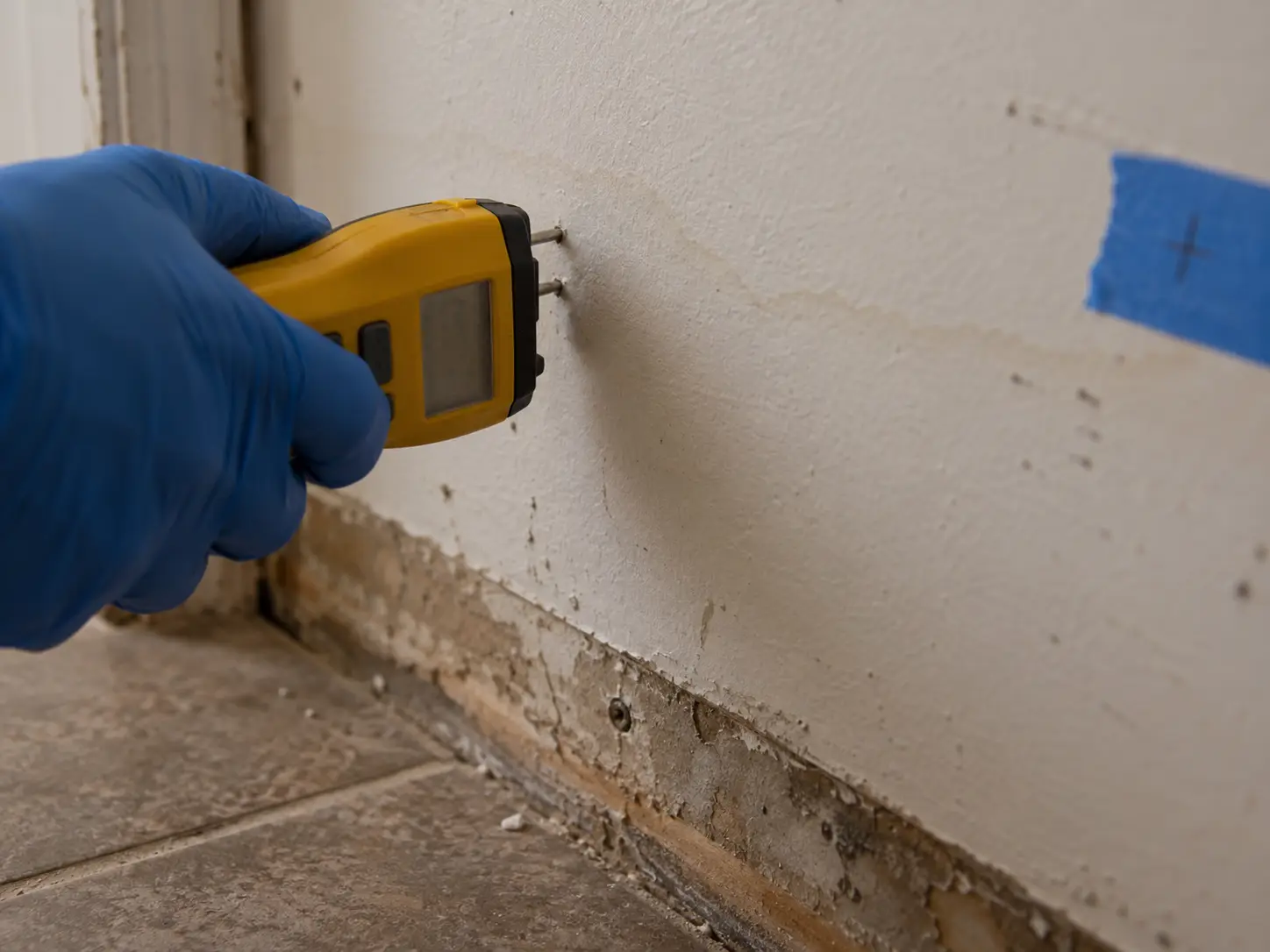
Drying is the part of the job you cannot see. EPA's guidance is to dry the house and everything in it completely (US EPA), and the S500 process starts with inspection and information gathering (IICRC). Before work starts, ask about their drying and moisture monitoring:
- What will you measure, how often, and will I get a copy of the readings?
- How will you decide that drying is finished?
- What will you remove, and why can it not be dried in place?
Written answers also help with your insurer, who will want the same record.
Read the estimate and contract before work starts
Get the scope in writing. Miami-Dade County lists a contractor unwilling to put all terms in writing, and a large down payment requested before work begins, as signs the contractor may not be licensed (Miami-Dade County). The Florida Attorney General's post-storm advice is similar: get multiple written estimates and never pay the full amount upfront (Florida Attorney General).
- Deposits: a contractor who takes more than 10 percent of the contract price as an initial payment for residential repair or restoration must apply for permits within 30 days and start work within 90 days after the permits are issued, unless you agree in writing to a longer period (s. 489.126).
- Recovery fund notice: a residential repair or restoration contract over $2,500 must include a written statement about the Florida Homeowners' Construction Recovery Fund (s. 489.1425). Its absence tells you something about the contract.
- Insurance benefits: for property policies issued on or after January 1, 2023, Florida law says post-loss benefits may not be assigned, and an attempt to assign them is void (s. 627.7152(13)). Read anything that mentions "assignment" or "direction to pay" carefully.
Our guide to restoration estimates has a worksheet for comparing two estimates line by line.
Find out who does the repairs
Many jobs have two phases: mitigation (extraction, removal of wet materials, drying) and repairs (drywall, flooring, cabinets). Some companies do both; others hand repairs to a separate contractor. Ask who will do the repairs, under whose license, and whether that is a separate contract. Florida's definition of mold remediation says work that requires a chapter 489 license must be done by someone licensed under that chapter (s. 468.8411), and Miami-Dade notes that a licensed contractor in good standing obtains the permit, so being asked to pull permits yourself is a warning sign (Miami-Dade County).
Warning signs
- An offer to pay, waive or rebate your insurance deductible. Florida law describes that, done knowingly with intent to defraud, as insurance fraud punishable as a third-degree felony (s. 489.147).
- Pressure to pay in full before work, or a verbal-only agreement (Florida Attorney General, Miami-Dade County).
- You are asked to obtain the permits yourself (Miami-Dade County).
- Mold removal offered with no Florida mold remediator license number.
- No legal business name you can find at the Division of Corporations, or an address that is a virtual office for a "local" company.
- Someone who shows up unsolicited after a storm (Florida Attorney General).
Call checklist and a worked example
Questions to ask on the first call. Write the answers down; they are your comparison.
- Do you serve my address, and will your own crew come?
- What is your legal business name? (Check it on sunbiz.org.)
- Which licenses cover my job, and what are the numbers? (Check them with DBPR.)
- Do you handle contaminated water, and how will you decide the category?
- What will you remove, what will you dry in place, and how will you show drying is finished?
- Do you do repairs, or is that a separate contractor and contract?
- Will I get a written, itemized estimate before work starts? What deposit do you ask for?
- Do you work with my insurer directly, and will I get copies of what you send them?
Illustrative example. The table below is made up to show how answers line up; it does not describe real companies.
| Question | Company X (illustrative) | Company Y (illustrative) |
|---|---|---|
| Serves my address | Yes, own crew | Yes, "partner technicians" |
| Business record | Active, address matches | Could not find the name given |
| Mold license (job has 20 sq ft of mold) | MRSR number given, current on DBPR | "Licensed and insured," no number |
| Drying records | Daily readings, copy to me | "We'll let you know when it's dry" |
| Repairs | Separate contract, named licensed contractor | Included, license not stated |
| Deposit | Under 10% | 50% before starting |
On these answers, Company Y has four open questions before it can be compared fairly. Need a crew in Miami? See our water damage services.
Water damage in Miami? Call us.
Tell us what happened and where. Our water damage restoration service in Miami connects you with a local restoration crew that serves your address.
Call (305) 555-0123Questions
Does a water damage restoration company need a license in Florida?
It depends on the work. Mold remediation of more than 10 square feet is defined as licensed work under s. 468.8411, and repair or construction work that falls under chapter 489 has to be done by a licensed contractor. Ask which license covers each part of your job and check the number with Florida DBPR.
What is an IICRC Certified Firm?
A firm certified by the IICRC, the body behind the ANSI/IICRC S500 water damage standard. Certification can be checked in the IICRC locator. It is an industry credential, not a Florida state license.
Can a restoration company ask me to sign over my insurance benefits?
For residential and commercial property policies issued on or after January 1, 2023, Florida law says a policyholder may not assign post-loss benefits, and an attempt to do so is void (s. 627.7152(13)).
How much deposit is normal?
Florida law does not cap deposits, but a contractor who takes more than 10 percent of the contract price as an initial payment for residential work must apply for permits within 30 days and start within 90 days after permits issue, unless you agree otherwise in writing (s. 489.126). Miami-Dade County lists a large down payment before work begins as a warning sign.
Can the same company test for mold and then remove it?
Florida law bars a mold assessor or the assessor’s company from remediating a structure it assessed in the last 12 months, and the reverse, with an exception for certain certified contractors (s. 468.8419). Ask whether the company that tests is independent of the one that removes.
Sources
- Florida Statutes: s. 468.8411, Mold-related services: definitions
- Florida Statutes: s. 468.8419, Mold-related services: prohibitions
- Florida DBPR: Mold-Related Services
- Florida DBPR: Emergency information: hiring a contractor
- Miami-Dade County: What to Know When Hiring a Contractor (brochure)
- Florida Statutes: s. 489.126, Moneys received by contractors
- Florida Statutes: s. 489.1425, Duty of contractor to notify residential property owner of recovery fund
- Florida Statutes: s. 489.147, Prohibited property insurance practices
- Florida Statutes: s. 627.7152, Assignment agreements
- Florida Statutes: s. 627.7142, Homeowner Claims Bill of Rights
- Florida Attorney General: Consumer alert: disaster-related scams (11 Oct 2024)
- US EPA: Flood Cleanup: Protect Indoor Air and Your Health
- US EPA: A Brief Guide to Mold, Moisture and Your Home
- IICRC: S500 Consensus Body position statement: Category of Water and Weather Related Events (2026)
- IICRC: IICRC Certified Firms
Sources were read on October 14, 2026. Something wrong or out of date? Send a correction.